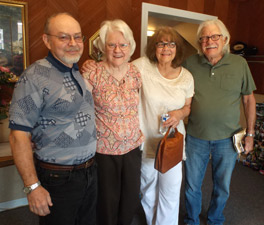
I see three groups of people in the world of invisible disabilities. First, I notice those living with chronic illnesses; my viewpoint is that of the hurting. Next, I recognize caregivers who also face great challenges; they have a distinct perspective. Third, I identify those who care but aren’t caregivers and who have an even different view. Each group has something unique to add to this community.
How three groups work together
On our special vacation several years ago, Joe and I camped near the town of Ione where we had lived for fourteen years. We met several friends at a restaurant for a fun time. I enjoyed myself so much that I didn’t watch my energy levels, becoming exhausted. As we walked out to our friends’ car, my walking was not so great. The wife, Bonnie, noticed. She and her husband, Wes, took us back to their home and insisted we stay until I regained my strength. They were very gracious and even invited more friends to their place for a meal. So, I was able to recover comfortably, and we were finally able to return to our campsite.
The picture above this post shows these three groups (left to right): Joe, the caregiver; me, the hurting; and Bonnie and Wes, the caring people.
Which group do you belong to? And how can you contribute to community?
Are you one of the hurting, struggling with pain, disability, difficult life situations? Feeling alone? Need to know someone is listening? Your caregiver or a caring person can help.
Maybe you are a caregiver to someone who hurts, and you are maxed out with the responsibility. Need a word or act from the caring? A caring person can fulfill your needs, or the one you care for might be able to help.
Or do you belong to the caring, and you’d like to be encouraging and strengthening? Or would you just like to learn more about us? The hurting or the caregiver can assist you in learning. And also be the recipient of your encouragement and aid.
Each group creates community
The invisibly disabled
Sometimes the chronically ill don’t see a storm coming.

- If isolated by your condition, proactively seek connections with others.
- Use computer, join social media groups, make phone calls, send cards.
- Give others a chance to help you.
- Remember to express gratitude to those who help.
- Don’t hide nor parade your problems.
The caregiver
Do I look like he’s helping me? Not at first glance! But look closer. I’m leaning a little bit and I’m holding on to him. He’s providing care by supporting me when I can’t stand by myself. A caregiver. Look carefully at my face. You can see some pain/fatigue there (or you could if you knew me well.) Joe notices and responds. Again, a caregiver.

- Show love and acceptance to the person you care for.
- Take care of yourself so you have energy enough to connect with the one you care for and with caring people.
- Keep up your social life, if possible.
- Try to help others understand the problems of the person you care for.
The caring person
The person outside the storms looking on can provide essential help.

- Look around and notice those who may not be participating.
- Ask if you can help, offering specific ideas.
- Even just noticing the person and saying, “Hello” helps.
- Seek to understand and accept an invisibly disabled person.
The hurting need encouragement, compassion, and a listening ear. The caregiver may need respite care or just a short break. The caring need someone to care for.
I hope that you who care about others will look around you and see the invisibly disabled; they are called “invisible” because their difficulties can be hard to see. Look closely, identify them, and see if they have needs you can help meet.
Share with us
Who helps you? Who do you help?
Learning more
If you would like to see not-to-do lists, check out Toni Bernhard’s articles: for caregivers and for chronically ill.
For more ideas about relationships, see Relational Issues page and posts on relationships.
To learn more about invisible disabilities, see these posts.