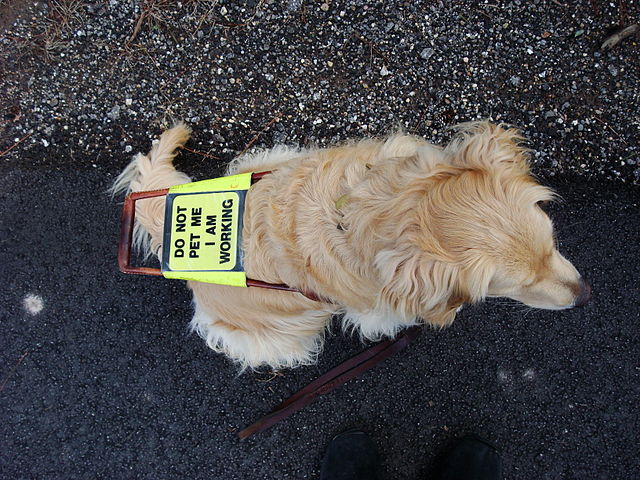
Do service dogs help invisibly disabled people? Yes. A new breed of service dog is here: he or she has special training to help his owner deal with anxiety and other invisible disorders. Misunderstanding of this issue is quite common. Disagreement about how these dogs should be recognized abounds.

guide dog in harness courtesy of Guide Dogs for the Blind
Imagine you’re a restaurant manager. At the door stands a man who’s not blind. He doesn’t appear to be deaf. He’s not using a wheelchair nor a cane.
Yet his dog wears a service animal vest. What do you do? Do you assume he’s just trying to take advantage of ADA rules to bring his pet in? Or do you assume he’s telling the truth and welcome him, as you would anyone else? Do you question him, trying to make him prove his right to bring in his dog? Do you call the police to remove him if he doesn’t leave?
Unfortunately, some people with invisible disabilities face this situation too often. The problem is compounded when people try to pass their pets off as service dogs. The ADA specifically defines service animals as dogs (and sometimes miniature horses). Sorry, you cat lovers. Though your cat may be special and helpful to you, it can never be considered a service animal.
What do service dogs do?
So, what does the ADA say about service animals? Dr. Laci Schaible quotes the ADA, ”dogs qualify as service animals when the owner has a documented disability, the dog is trained to perform a task to alleviate that disability, and the animal’s presence in public does not alter the environment for others.”
Service dogs have been trained to help their owners by performing specific activities. We are familiar with dogs for the blind and deaf; we can understand dogs that help people in wheelchairs. But can service dogs help invisibly disabled people?
Their owners think so. Suzanne Brean suffers from PTSD and anxiety and seizure disorders. She and her husband started Dogs for Invisible Disabilities, a volunteer group that trains well-behaved dogs for their owners who have disabilities.
Her dog, Wyatt, a 4-year-old English Labrador Retriever, “will alert Suzanne to her seizures by a couple of minutes to a couple of hours. She says, ‘He guides me when I have anxiety issues,’ she said. ‘He can take me to the nearest exit or I can tell him to find the car.’
Wyatt also helps her with stability issues after seizure episodes, because she tends to be unstable.
Suzanne can also use him as a brace to help her get up. ‘If I’m laying down and need help getting up, he’ll actually go lay down underneath me then help me get on top of him and he’ll stand up,’ Suzanne said.”
What kinds of disorders can be helped?
- PTSD
- Anxiety disorders
- Autism
- Seizure disorders
- Diabetics
- Walking, stability, bending over issues
What can a trained service dog do?
- Help someone get up after a fall.
- Provide stability to help a person walk.
- Pick things up off the floor.
- Get cash from an ATM!
- Alert that a seizure or manic, anxiety or panic attack is imminent.
- Get the person to safety in above situations.
- Alert someone about low blood sugar.
- One dog dialed 9-1-1 after his owner had collapsed with a seizure.
For PTSD, the dog can interrupt flashbacks and nightmares; reduce anxiety and stress; comfort the person as he gets back to normal; and help his owner regain self-assurance.
In addition to general training as a guide dog, these dogs are trained for specific individuals and their specific needs. So the list above can be expanded to include whatever the individual needs help with.
So, the question – for real? service dogs help invisibly disabled? – is a resounding YES!
This week we dealt with how service dogs help invisibly disabled people. My next post deals with the training of these dogs and how a service dog differs from pets (even special ones)and therapy, social, and facility animals.
For anyone interested in pursuing this subject, here are some good articles: Six decisions to consider; More than just a pet; ADA regulations.
Where do you stand on these issues? Do you think dogs can provide this kind of help? Leave an answer in Comment Section
til next time, Connected Carole