Last time, I shared my story of using aids to help me “walk” and how they enable me to spend more time with family and to accomplish practical tasks. However, as I researched these devices, I discovered many more mobility aids for chronically ill people. They come in many shapes and sizes meeting different needs. But all have the same goal: to enable the person more freedom to participate in life and to have more independence.
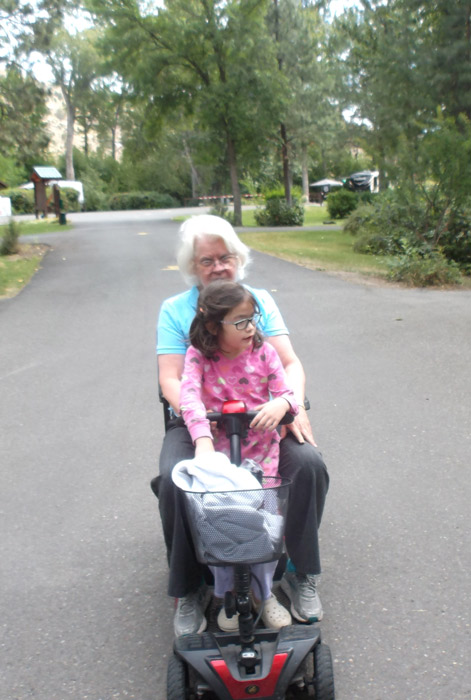
When we go camping, I can no longer walk around the perimeter. But with my scooter, I can not only “walk,” I can carry a passenger (my granddaughter). I was hesitant at first to use a wheelchair, knowing I could get out of it at any time. But, the pleasure of spending more time with my family on our vacation outweighed the embarrassment of wondering what other people thought on those occasions when I walked away.
If you do not currently use a mobility aid but are weak or have other difficulty locomoting, I trust this information will encourage and inform you.
Thankfully, we live in an age with a variety of mobility aids for chronically ill people; they make life so much easier. Listed below are some reasons you might need one and numerous types of differing devices. What a variety! I never knew there were so many.
If one catches your fancy, Google it for more info and then talk to your doctor or therapist. They can help you make decisions, write a prescription (for insurance), and help you learn how to properly use it. Mobility aids are unsuited for self-teaching.




Reasons to use an aid
- Improves stability and balance.
- Broadens base of support.
- Redistributes weight from lower limbs to arms or walking aid.
- Reduces disability.
- Delays decline of function.
- Increases activity levels.
- Generates movement.
- Enables independence.
Types of mobility aids
- Crutches
- Forearm crutch
- Hands-free crutch
- Folding crutch
- Cane
- Quad cane
- Folding cane
- Seat cane
- Cane with curved handle
- Cane with straight handle
- White cane (or seeing-eye dog) for blind
- Walker
- Walker with no wheels
- Two-wheel walker
- Two-wheel walker with seat
- Four-wheel walker
- Four-wheel walker with seat
- Three-wheel knee walker
- Folding walker
- Child/toddler walker
- Extra-wide walker
- Posterior posture walker
- Walker cane hybrid
- Wheelchair
- Manual wheelchair
- Power wheelchair
- Normal, lightweight, heavy duty wheelchairs
- Wheelchair in a bag (see Bimbler link below)
- Transport wheelchair
- Reclining back wheelchair
- Bathroom wheelchair
- Sport wheelchair
- Beach and pool wheelchair
- Kids wheelchairs
- Scooter, motorized
- Three-wheel scooter
- Four-wheel scooter
- Heavy-duty scooter
- Portable/travel scooter
- Outdoor scooter
- All-terrain scooter
- Two-person scooter
- Seated walking scooter
- Gait trainer
- For pre-ambulatory skills development when person is unable to consistently bear weight through legs.
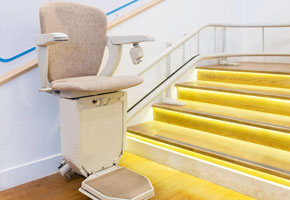
- Stairlifts
- Power chair attached to stairs allowing person to get from one floor to another.
- Available in straight, curved, or commercial types.
- I “climbed” up to the museum while seated on my scooter on a commercial stairlift.
Whew!
What a list of different aids to help us invisibly disabled people maneuver in the mobile world! Be sure to check with your healthcare professional if you are interested in finding out more.
Summing up
Now that you’ve seen the wide variety of mobility aids for chronically ill people, what do you think? Do you use one? If not, do you need one? Take time to think about it. Discuss with your healthcare professional. Then decide what will help you best be able to participate in and enjoy life.
Share with us
What do you think about using a mobility aid?
For Further Investigation
See info about choosing the right assistive walking device, especially for those with MS.
This article about types of mobility aids available offers even more info concerning choices.
For Connected Carole’s history with Assistive Devices for Walking, see her post.
The Bimblers’ travel and lifestyle blog also has info about mobility aids. They travel despite disabilities.